

Studio Reflections
How A Year on YouTube & One Mixed Media Piece Changed the Way I See My Art

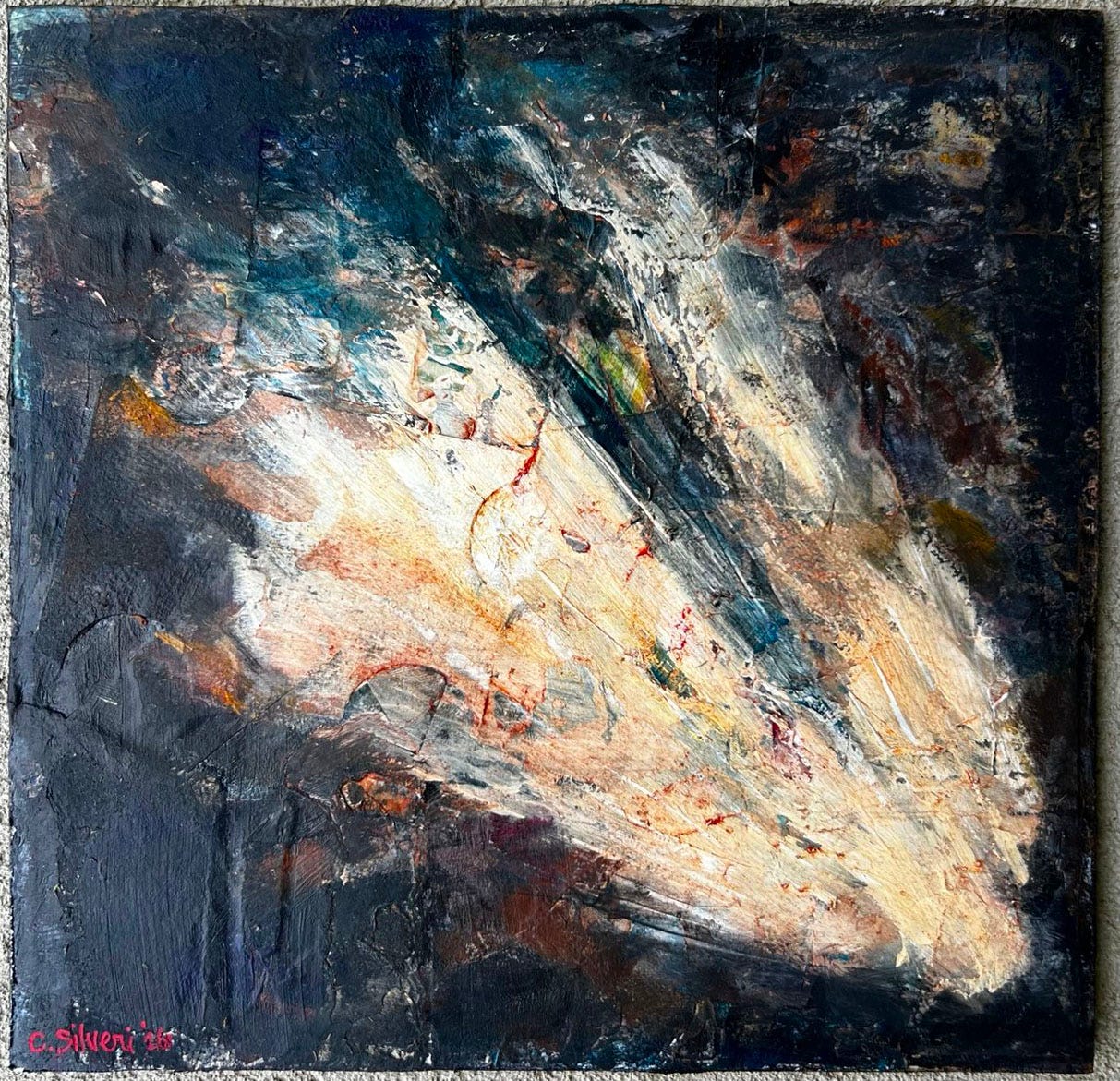
Reentry, 10” x 10” Mixed Media on Panel 2026
Although I’ve always considered myself artistic, I never really thought of myself as a real artist. I spent years making this, that, and the other—experimenting with different media, chasing ideas, and wondering if I’d ever “find my style.” (If you’ve read any of my previous posts on this Substack you’ll see evidence of that!) And, if you read my previous post about completing a year of consistently posting videos on YouTube, you know I’ve been making a lot of art over the past year. It’s been a fascinating journey, one that has taught me something I didn’t expect: the artist I’d always hoped to become wasn’t waiting for the perfect idea or the perfect style. It happened because I kept showing up and making art.
Last May, when I committed to posting one art video a week on YouTube, I struggled with the question of what to make. I experimented with a variety of media and techniques before gradually discovering what felt most authentic to me, a process that took the better part of a year. Over the past two months, I created twelve artworks, each beginning with layers of scrap paper collage on a 10-inch square Masonite panel. From there, I responded to each surface through sanding, acrylic paint, and water-based media. Rather than following a plan, each work emerged through observation, curiosity, and discovery. In this way, my work began to develop a sense of cohesion, and the more I paid attention to what was already there, the more each piece seemed to reveal itself.
So after finishing these twelve pieces I thought I’d reflect on each one, recalling how they came to be. As I began thinking about the first piece, something unexpected happened. I found myself remembering much more than the work itself. I remembered why I started the series, what I was afraid of, what surprised me, what I learned.
That conversation with myself convinced me these stories are worth preserving, because creativity rarely moves in a straight line. One painting teaches the next, and the next often sends me back to the original with new understanding. Sometimes we have to move forward before we can truly see what came before. Sometimes a title I gave to a piece means one thing when first given and something entirely different a few weeks or months later.
Today’s essay is the first in a series I will be sharing over the coming weeks, in which I’ll focus on each work one at a time: the finished work, the story behind it, what it taught me, and how it shaped the works that came next. I hope these reflections will be interesting to fellow artists, but I also hope they’ll resonate with anyone who’s ever wondered whether their own creative voice was still waiting to be discovered. I’m convinced it’s never too late.
Studio Reflection 01: I Interview Myself
Reentry, 10” x 10” Mixed Media on panel
What inspired you to start this piece?
After seeing another artist build up collage layers and sand them back, I became interested in that idea. I already had several unfinished 10×10 collage panels from several years earlier, so I decided to use them as an experimental foundation. I recorded some live videos at the start of this mixed media series, asking questions like: “Can scraps become good art?” Reentry was the very first panel I explored.
At first, I sanded back the layers of collage and painted it over using black and deep blue. I wasn’t sure how to respond to how it looked. It had a lot of texture but lacked contrast, so I painted a bold white streak across it. At that point I thought it was finished. I named it Light Shining into Darkness—a beam of light shining into darkness because originally it was oriented upside down from where it is now. After completing several more panels, however, I began to understand something about my own work. The stark white against the black felt too abrupt, too harsh—too literal. By applying a warm reddish-orange tone glaze and rotated the panel 180 degrees, suddenly it became something entirely different: a fiery object moving through space. That transformation led to its final title: Reentry.
What materials or techniques were new for you when you made this piece?
This painting marked my first real exploration of mixed media abstraction as my own artistic language. Although I had used acrylic paint before—mostly with stencils—it had never been my primary painting medium. This was one of the first times I was using acrylics to build an expressive painting rather than simply applying color for a specific purpose. Collage itself wasn’t entirely new either. I had previously taken a collage course, but those pieces were responses to class assignments. When I began these 10×10 panels a few years earlier, I was suddenly working without assignments or direction. I started several panels, but eventually set them aside because nothing was really speaking to me. Looking back, I realize I was thinking only about collage. I wasn’t yet thinking as much about mixed media. This series became the moment when those ideas merged. Instead of collage being the finished composition, collage became one voice among many—combined with sanding, paint, water, ink sprays, glazing—a continual response to what was already there. In many ways, this painting represents my first genuine step into creating mixed media abstract work that felt like it belonged to me rather than to an assignment or a technique.
Was there a moment when you thought it wasn’t going to work?
I never really felt that. I did reach a point where I knew it wasn’t finished, and I didn’t know what the solution would be to finishing it. I set it aside and continued working on other panels, and as I experimented with new ways of responding to the work, I gradually developed a broader visual vocabulary. Those later discoveries eventually gave me the answer this piece had been waiting for. Around the middle of the series, I realized that transparent layers could soften relationships, unify colors, and create atmosphere in ways that opaque paint couldn’t. When I came back to this painting, glazing became the key that transformed the harsh white into something that belonged within the painting. Another important discovery was rotation. Working from one orientation, I assumed that I knew it was the correct one, only to surprise myself by finding a much stronger composition in a completely different direction. That practice fundamentally changed how I worked. Instead of telling the painting what it was supposed to be, I learned to ask what it wanted to become. Looking back, this painting became one of the first examples of that shift in my process.
Was there a moment of surprise or discovery—something that happened during or after making this painting that you never could have planned?
Yes. The biggest surprise wasn’t the glaze or even rotating the painting. It was discovering what the layers themselves could do. By building up collage, sanding it back, adding paint, and allowing parts of those earlier decisions to remain visible, the piece developed a richness that I realized I could never intentionally invent. The history embedded in the surface created a depth and complexity that wasn’t planned—it emerged. That realization changed the way I looked at the entire series. I understood that the collage wasn’t simply something to cover or be covered, but I had not anticipated the extent to which it was contributing to the finished painting in ways that were impossible to recreate. All of those paper layers became part of the final surface that I literally couldn’t recreate from scratch if I tried. The piece is utterly unique and unrepeatable. This helped me appreciate that these works are records of their own making. The visible layers gave them a complexity and authenticity that could only come from the process itself. I also realized that I wasn’t interested in making artwork that I could copy. The layered history and countless small decisions made each piece impossible to duplicate. I didn’t view this as a limitation; it became one of the things I loved most about this process. Every one of these pieces carries its own history, and that history can never happen exactly the same way twice.
Looking at it now, is there anything you would never change?
I would never change the number of collage layers beneath the surface. There were quite a few layers glued down before I ever began sanding or painting, and I think that accumulated history is what gives this piece its richness. When you look closely, you can sense that there is far more happening beneath the surface than what is immediately visible. Those hidden layers create a complexity that couldn’t be achieved by simply painting the same image. They give the surface depth, mystery, and a feeling that the painting has lived a life before arriving at its final form. Looking back, I realize those layers are not just the foundation but are an essential part of its identity.
How do you feel about this painting today?
Today, I see this painting very differently than when I made it two months ago. Its title, Reentry, has taken on a meaning I never intended when I renamed it. At the time, I was thinking about a fiery object returning through the atmosphere. Looking back now, I realize the title also describes something much more personal. This painting marks the beginning of understanding my own visual language. For years I experimented with different materials, techniques, and ideas, always feeling as though I was searching for something I couldn’t quite define. With this series, something shifted. The process, the materials, and the way the paintings emerged all began to feel deeply authentic to who I am as an artist. Creating Reentry was the first time I sensed that I had stopped trying to make art and had begun making my art. Looking back now, the title feels surprisingly fitting after all.
What did this painting teach the next painting?
This first painting gave me permission to keep going. It taught me not to be afraid of making a mistake. And because it was the first panel in the series, I didn’t have any expectations yet. I discovered that a painting didn’t have to be perfect on the first attempt. I could set it aside and come back later with new ideas: paint over it, sand it, rotate it, glaze it, add more collage. That realization changed everything. Instead of worrying about getting the next painting “right,” I became more willing to explore. Each panel became an opportunity to learn rather than a test of whether I was a good artist. Looking back, I think this painting gave me the confidence to continue with the rest of the series.
Thanks for reading! (If you enjoyed this and would like to see my process, you can visit my YouTube Channel where most of this type of work can be found under the “live” tab or in the Creative Explorations playlist.)
Cynthia
Beautiful piece, Cynthia. I love the abstract realism, and oddly it reminds me of the Chauvet Caves. Congrats.